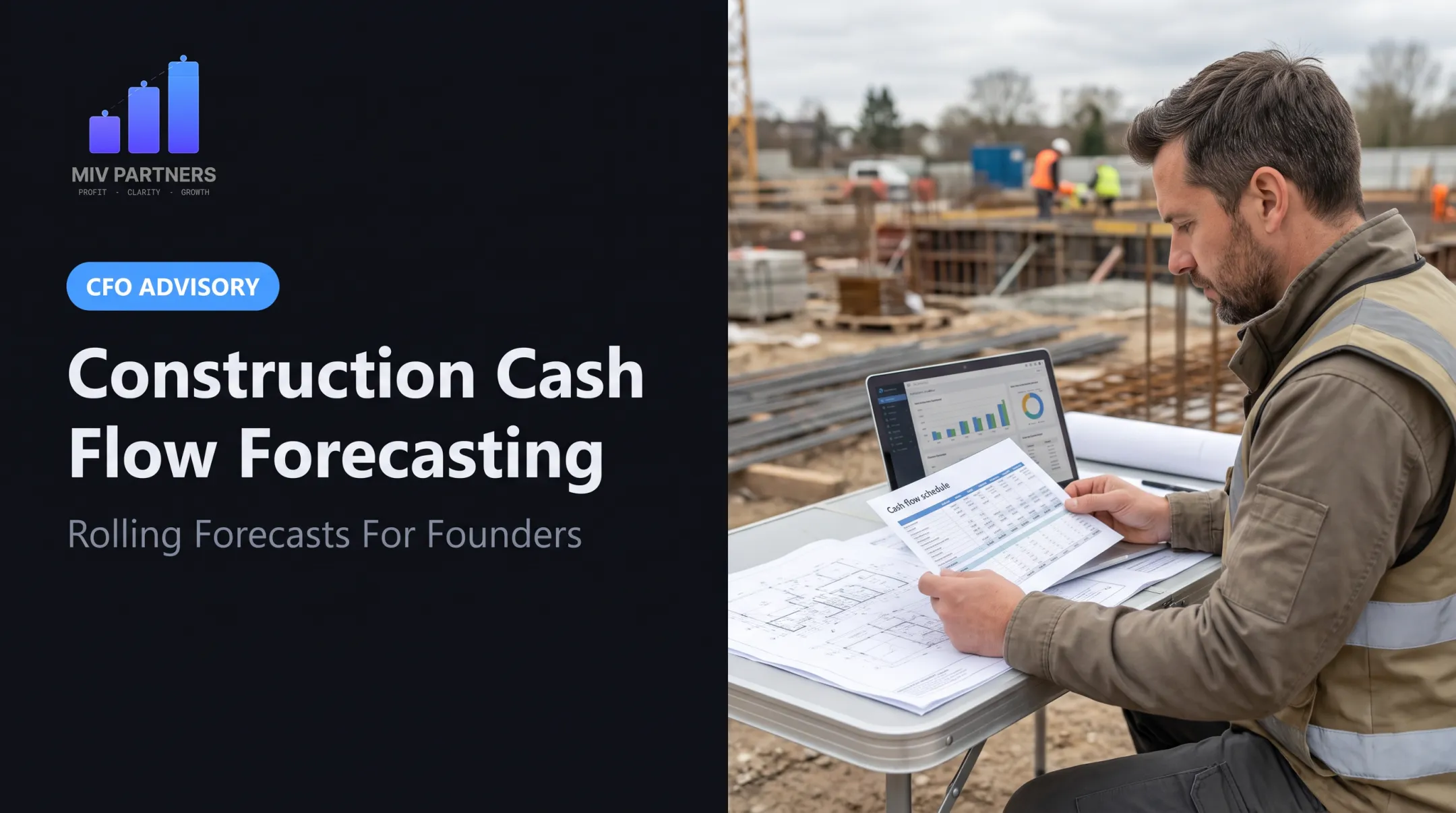

The Federal Reserve's 2024 Small Business Credit Survey found that 51% of firms cited uneven cash flows and 75% cited rising costs as ongoing pressures. This is not a small business problem limited to startups. It hits established, profitable, founder-led companies too.
A cash flow projection is the tool that catches this before it becomes a crisis. Unlike financial statements that report what already happened, a projection estimates cash coming in and going out over a future period, so you can spot a shortfall while there's still time to act.
This article breaks down what a cash flow projection is, its core components, how to build one, common mistakes to avoid, and when it's time to bring in outside expertise.
Key Takeaways
- Projects future inflows and outflows so you can spot shortfalls before they hit
- Differs from a cash flow statement (historical) and a budget (plan, not timing)
- Accuracy depends on realistic assumptions about receivables, payables, and expense timing
- A rolling 12-month forecast updated monthly beats a static annual projection
- Businesses past bookkeeping often need CFO-level support to build and use projections
What Is a Cash Flow Projection?
A cash flow projection is an estimate of the cash you expect to receive and pay out over a specific future period. Inflows include customer receipts, loan proceeds, and deposits. Outflows include payroll, vendor payments, rent, and debt service.
A projection answers one practical question: will there be enough cash on hand to cover what's coming due?
How This Differs From Other Financial Reports
Founders often confuse three distinct documents:
- Cash flow statement — backward-looking, showing what actually happened last month or quarter
- P&L (income statement) — accrual-based, meaning it counts revenue when earned, not when cash actually lands
- Cash flow projection — forward-looking, tracking the timing of cash movement, not just totals
This distinction explains a scenario many founders know too well: a business posts a strong profit on paper while its checking account runs dry. A big invoice sitting unpaid for 60 days looks great on the P&L. It does nothing for payroll due next Friday.
Choosing the Right Time Horizon
Not every business needs the same level of detail:
- Weekly — useful when cash is tight or a specific low-cash period is approaching
- Monthly — the standard operating view for most founder-led businesses
- Rolling 12-month — ideal for spotting seasonal patterns and planning around known slow periods
Revenue growth alone won't fix cash timing problems. A company can be genuinely profitable and still run short if customers pay slowly while vendors expect payment fast. That gap is exactly what a projection is built to expose.
Key Components of a Cash Flow Projection
Every cash flow projection, regardless of format, comes down to four building blocks.
Beginning Cash Balance
This is the cash sitting in your account at the start of the period. It carries forward directly from the prior period's ending balance, so month two's opening number should match month one's closing number exactly.
Cash Inflows (Sources of Cash)
Typical inflow categories include:
- Receivable collections from prior sales
- Direct cash sales
- Loan proceeds or draws on a line of credit
- Customer deposits or prepayments
- Proceeds from asset sales
The critical assumption here is collection timing. If 40% of invoices get paid in 30 days and the rest stretch to 60 or 90, your projection needs to reflect that reality, not the payment terms printed on your invoice.
Cash Outflows (Uses of Cash)
Common outflow categories include:
- Payroll and contractor payments
- Vendor and supplier payments
- Rent, utilities, and insurance
- Loan and debt payments
- Owner compensation and taxes
- Capital purchases (equipment, buildout, etc.)
Just as collection timing matters on the inflow side, payment timing matters here. Some vendors expect net-15. Others allow net-60. Mapping actual payment dates, not just due dates, is what makes the projection usable.
Ending Cash Balance / Net Cash Position
The formula is straightforward:
Beginning Cash + Inflows − Outflows = Ending Cash Balance
A negative ending balance in any given month is your early warning system. It tells you, weeks or months in advance, that you need to accelerate collections, delay a purchase, or arrange financing before the gap actually opens up.

How to Build a Simple Cash Flow Projection
You don't need specialized software to get started. A spreadsheet and a few hours of focused work will get you a working first draft.
- Gather historical data: Pull bank statements, invoices, and past expense records. Assumptions grounded in your actual payment history beat guesswork every time.
- Set up your spreadsheet: List months across the top as columns and stack your inflow/outflow categories down the left side.
- Build realistic timing assumptions: Base collection and payment timing on what has actually happened, not what your invoice terms say should happen. Avoid optimism bias here; it's the single biggest reason projections fail.
- Calculate net cash flow and ending balance: Do this for each month and flag any month where the ending balance goes negative or drops below your minimum comfort threshold.
Here's a simplified illustration of the format:
| Line Item | Month 1 | Month 2 | Month 3 |
|---|---|---|---|
| Beginning Cash Balance | $50,000 | $58,000 | $41,000 |
| Total Cash Inflows | $85,000 | $70,000 | $90,000 |
| Total Cash Outflows | $77,000 | $87,000 | $80,000 |
| Net Cash Change | $8,000 | ($17,000) | $10,000 |
| Ending Cash Balance | $58,000 | $41,000 | $51,000 |
Notice Month 2's dip. That's exactly the kind of signal a projection is supposed to catch. You see it weeks ahead, not the day payroll bounces.
Common Mistakes That Undermine Cash Flow Projections
Even a well-intentioned projection can mislead you if it's built on the wrong assumptions. The U.S. Small Business Administration has flagged several recurring budgeting and forecasting failure patterns—patterns that show up often when profit is confused with cash or categories are misaligned.
Watch for these specific traps:
- Overly optimistic collection assumptions — Projecting that customers will pay on invoice terms when your actual history shows otherwise
- Ignoring seasonal swings and irregular costs — Triple-payroll months, annual premiums, or slow seasons break "typical month" models
- No cash buffer or scenario planning — Building only a best-case view, with no worst-case or most-likely alternative
- Treating it as a one-time exercise — A projection built in January and never touched again is stale by March

The fix for all four is the same: update the model regularly and compare it against actual results.
Why Founder-Led Businesses Struggle With Cash Flow Projections
Once a business grows past its startup phase, receivables and payables cycles get more complicated than basic bookkeeping was ever designed to track. Multiple customer contracts, staggered vendor terms, seasonal revenue, and growing payroll all add layers that a monthly bank reconciliation simply doesn't capture.
Founders running $1M–$15M businesses face a second constraint: day-to-day operations crowd out finance work. Sales calls, hiring, operations, and client delivery leave little room to build and maintain a rolling 12-month forecast, even though that forecast is the tool that prevents the next cash scare.
MIV Partners addresses both the complexity and the time problem. Michel Chelnokov, founder of MIV Partners, works exclusively with founder-led businesses in this revenue range through a structured Diagnose, Strategize, and Install model:
- Diagnose — Review expected inflows and outflows, working capital, receivables, payables, and cash conversion to pinpoint where cash is actually getting stuck
- Strategize — Build a forward-looking plan that stabilizes cash flow and anticipates constraints before they hit
- Install — Put executive dashboards and rolling forecasts in place that get updated monthly, turning the projection from a static document into a real decision-making tool
Engagements typically start with a complimentary CFO Financial Diagnostic session. It's a no-cost, no-commitment way to get a clear read on where cash and margin opportunities exist before deciding on next steps.
Frequently Asked Questions
How often should a cash flow projection be updated?
Update it monthly, using a rolling 12-month approach. Compare actuals against your projections regularly and adjust assumptions as your business changes.
What should a cash flow projection look like?
A simple spreadsheet with monthly columns, tracking beginning cash balance, inflows, outflows, and ending cash balance for each period. Complexity can grow, but the core structure stays this simple.
Can you provide a simple example of a cash flow statement?
If sales inflows total $85,000 and expense outflows total $77,000 in a month, your net cash flow is $8,000. Add that to your beginning balance to get your ending cash position.
What is the purpose of a cash flow projection?
It anticipates cash shortfalls or surpluses before they happen, giving you the runway to make informed decisions on hiring, financing, and growth timing.
Why do small businesses struggle with cash flow?
Common causes include slow-paying customers, seasonal revenue swings, and a lack of forward planning. Many businesses react to cash problems instead of forecasting for them.
What is a 3-way cash flow forecast?
It's an integrated model linking the P&L, balance sheet, and cash flow statement. Changing one assumption flows through all three, giving a fuller picture than a cash-only projection alone.