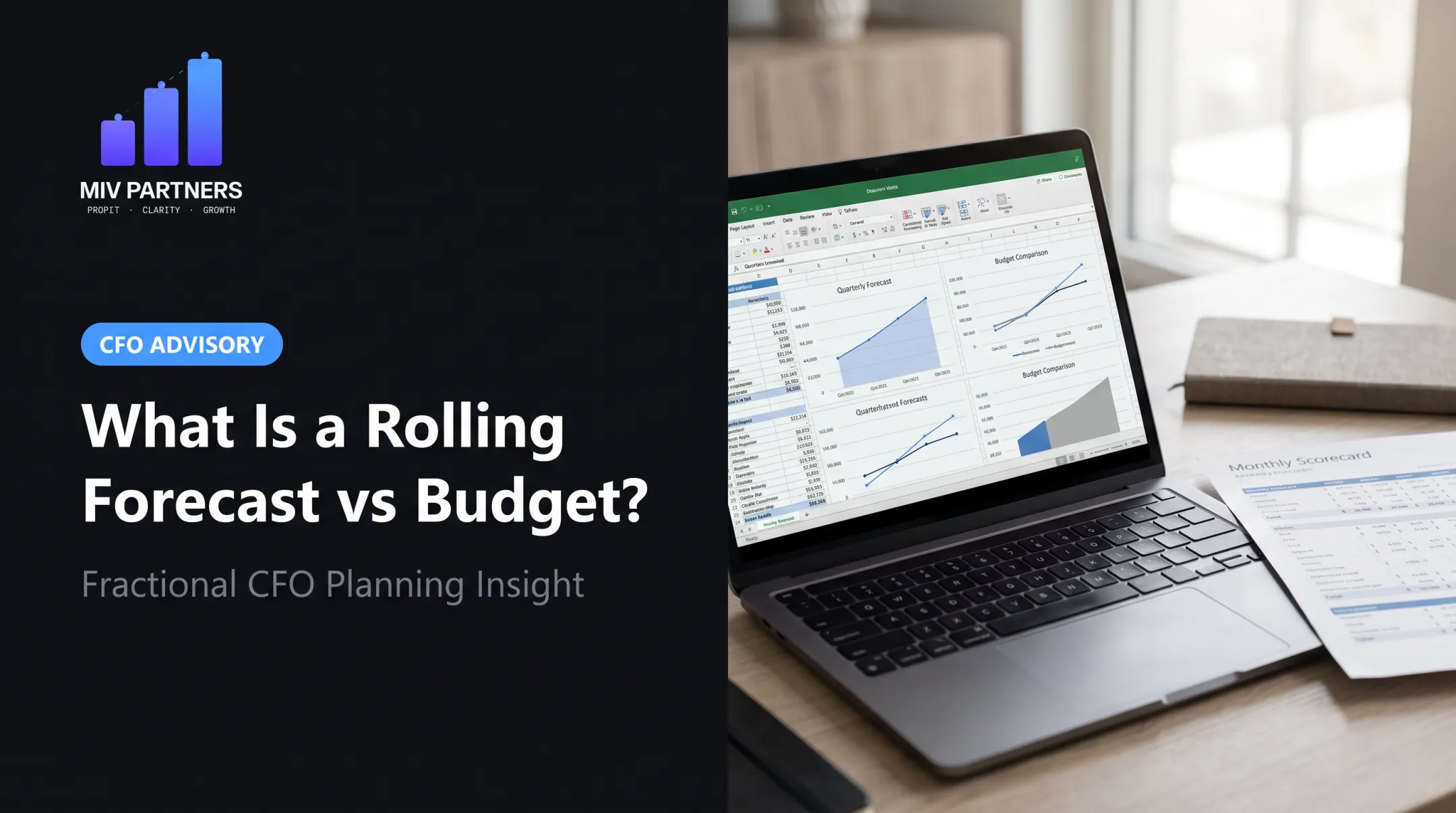

The culprit is often a basic mix-up: treating a budget and a forecast as the same tool. They're not. A budget tells you what should happen this year. A forecast tells you what's likely to happen right now, based on current reality.
The Federal Reserve's 2025 employer-firm survey found that 56% of businesses cited paying operating expenses and 51% cited uneven cash flows as ongoing challenges. That's not a small-business quirk. It's a planning gap.
This guide breaks down what budgeting and forecasting actually mean, how they differ, the steps behind each, and why so many growing companies struggle to keep both running at once.
Key Takeaways
- Budgets set targets; forecasts track reality. You need both, not one or the other
- Static annual budgets lose relevance fast when market conditions shift mid-year
- Rolling forecasts, updated monthly, give founders a current view instead of a stale one
- Cross-functional input and driver-based models cut forecast variance
- A fractional CFO can build both systems without the overhead of a full-time hire
What Is Budgeting and Forecasting?
What Is a Budget?
A budget is a structured financial plan. It allocates expected revenue and expenses across a defined period, usually 12 months. Think of it as a roadmap: it sets the destination and the route before the trip starts.
The Association for Financial Professionals defines budgeting as a detailed plan of expected revenues, expenses, and capital expenditures for a set period—usually a fiscal year—used for planning, control, and communication.
A good budget does three things:
- Sets measurable financial targets by department or category
- Creates accountability for spending decisions
- Gives you a baseline to measure actual performance against
What Is a Forecast?
A forecast is a prediction. It estimates future financial outcomes using historical data, current trends, and known assumptions. Unlike a budget, a forecast isn't fixed for the year — it gets refreshed monthly or quarterly as conditions change.
The Government Finance Officers Association treats forecasting as an ongoing process: monitor it, update it, and never treat it as a one-time exercise.
Here's the relationship in plain terms: your budget says "here's the plan," your forecast says "here's where we actually stand." Run side by side, they create a feedback loop that flags gaps early—before a cash crunch or missed target turns into a crisis.
Key Differences Between Budgeting and Forecasting
The core distinction is simple. A budget says what should happen. A forecast says what will likely happen.
| Factor | Budget | Forecast |
|---|---|---|
| Time horizon | Fixed period, usually 12 months | Rolling, often 3-18 months out |
| Update frequency | Set once, revisited annually | Monthly or quarterly |
| Level of detail | Line-item, department-level | Driver-based, higher-level trends |
| External factors | Assumed at time of creation | Adjusted as conditions change |

Deloitte's research on planning and forecasting found that organizations with a shared understanding of these processes are far more likely to have connected planning functions — 76% versus 58% without that alignment.
The same research linked cross-functional participation in forecasting to lower variance: 77% of companies with high cross-functional input kept forecast-revenue variance below 10%, compared to 59% with less collaboration.
Why relying on a budget alone gets risky:
- Market conditions shift, but the annual budget doesn't
- Costs creep up mid-year while the plan stays static
- Decisions get made against numbers that no longer reflect reality
For founder-led businesses specifically, a rolling forecast often delivers more practical value than a rigid annual budget. Revenue mix changes, hiring plans shift, and a single fixed target rarely survives contact with a full year of real operations.
5 Steps of Effective Budgeting
A workable budget comes from a repeatable process, not a finance department.
- Review historical data. Pull prior-year actuals for revenue, expenses, and margins. This is your starting baseline, not a guess.
- Project revenue conservatively. Use realistic assumptions tied to actual pipeline and sales history, not best-case scenarios.
- Allocate expenses by category. Break fixed costs (rent, salaries) and variable costs (materials, commissions) into departments or cost centers.
- Set margin targets. Align spending decisions with the profit goals you actually want to hit, not just revenue growth.
- Build a variance review process. Compare budget to actuals every month so gaps surface while you can still act on them.
Skipping step five is where budgets go stale. Without a review cadence, a budget becomes a document nobody looks at past January.

7 Steps of Financial Forecasting
Forecasting works differently. It's less about setting a target and more about building a repeatable process for reading what's ahead.
- Define the time horizon and objective. Are you forecasting cash for the next 90 days, or revenue for the next three quarters?
- Gather historical data. Pull financial and operational numbers—revenue by line, collections, and headcount—not just accounting entries.
- Identify trends and seasonality. Look for demand drivers, seasonal dips, and patterns in customer behavior.
- Select a forecasting method. Straight-line, moving average, or regression, depending on data quality and business complexity.
- Build the model and test scenarios. Run best-case, base-case, and worst-case versions so you can see how cash and profit move if sales slip or costs spike.
- Communicate assumptions clearly. Every number in a forecast rests on an assumption. Stakeholders need to know what those are.
- Monitor and revise regularly. A forecast that isn't updated is just an old guess.
Method choice is where many forecasts go wrong. The Association for Financial Professionals notes that moving averages work well for short-term, stable cash flows but can lag behind sudden trend shifts. Regression models perform better when multiple business drivers genuinely influence outcomes.

Common Types of Budgeting and Forecasting Techniques
Not every method fits every business. Match the approach to your stability, growth stage, and data quality.
Budgeting approaches:
- Zero-based budgeting — every expense must be justified from scratch, no assumed carryover
- Incremental budgeting — builds on last year's numbers with small adjustments
- Activity-based budgeting — ties costs directly to the activities that drive them
- Rolling budgeting — updates continuously, often quarterly, instead of once a year
Forecasting techniques:
- Straight-line forecasting — assumes historical growth rate continues unchanged
- Moving average forecasting — smooths out short-term fluctuations using recent data
- Regression forecasting — links outcomes to specific business drivers like sales volume or days sales outstanding (DSO)
The right method depends on business stability, growth stage, and how much clean historical data you actually have. A five-year-old business with steady operations might do fine with incremental budgeting. A fast-growing company with shifting margins usually needs something more dynamic, such as rolling budgets paired with driver-based forecasts.
Why Founder-Led Businesses Struggle with Budgeting and Forecasting
Businesses in the $1M–$15M range hit an odd gap. They've outgrown basic bookkeeping, but they're not big enough to justify a full-time CFO. The result is a planning vacuum.
Common symptoms of this gap:
- Annual budgets built once and never revisited
- No rolling forecast, so leadership reacts to problems instead of anticipating them
- Cash flow surprises despite revenue growth
- Unclear profitability by product, service, or job
- Major decisions (hiring, expansion, financing) made without solid financial data
That vacuum sticks around because founders stay pulled into operations, sales, and delivery. Finance systems get deferred until a cash crunch forces the issue.
MIV Partners focuses on this stage of growth. Founder Michel Chelnokov, a CPA and MBA with over 20 years of finance and strategy experience, built the firm's Diagnose, Strategize, and Install model specifically for founder-led businesses in this range.
How the model closes the gap:
- Diagnose — assess current profitability, cash position, margins, and financial risks
- Strategize — build a financial roadmap, pricing model, and capital plan
- Install — implement executive dashboards and rolling forecasts that replace reactive planning
Once those systems are in place, monthly reviews compare actuals against budgets and forecasts. Leadership tracks KPIs and catches cash flow issues early, without the overhead of a full-time finance hire.
For founders unsure where their gaps actually are, MIV Partners offers a complimentary CFO Financial Diagnostic session as a low-risk starting point. No commitment, just a clearer picture of where the planning breaks down.
Frequently Asked Questions
What is budgeting and forecasting?
Budgeting creates a structured financial plan for a set period, usually a year. Forecasting predicts likely outcomes based on current data and trends. Together, they form a "plan vs. reality" system for financial decision-making.
What's the difference between budgeting and forecasting?
A budget says what should happen; a forecast says what will likely happen. Budgets are often set annually, while forecasts update monthly or quarterly as conditions change.
What are the 5 steps of budgeting?
Five steps: review historical data, project revenue conservatively, allocate expenses by category, set margin targets, and establish a monthly variance review comparing budget to actuals.
What are the 7 steps of forecasting?
Seven steps: define the horizon, gather historical data, identify trends, select a method, build the model with scenarios, communicate assumptions, and monitor results to revise regularly.
Can you pay someone to create a budget for you?
Yes. CPAs, bookkeepers, and fractional CFOs can build and manage budgets. Fractional CFOs like MIV Partners typically handle strategic budgeting and forecasting, while bookkeeping stays separate.
What are the types of budgeting?
Common types include zero-based, incremental, activity-based, and rolling budgeting. Each fits different business stages, from stable operations to fast-growing companies needing frequent updates.