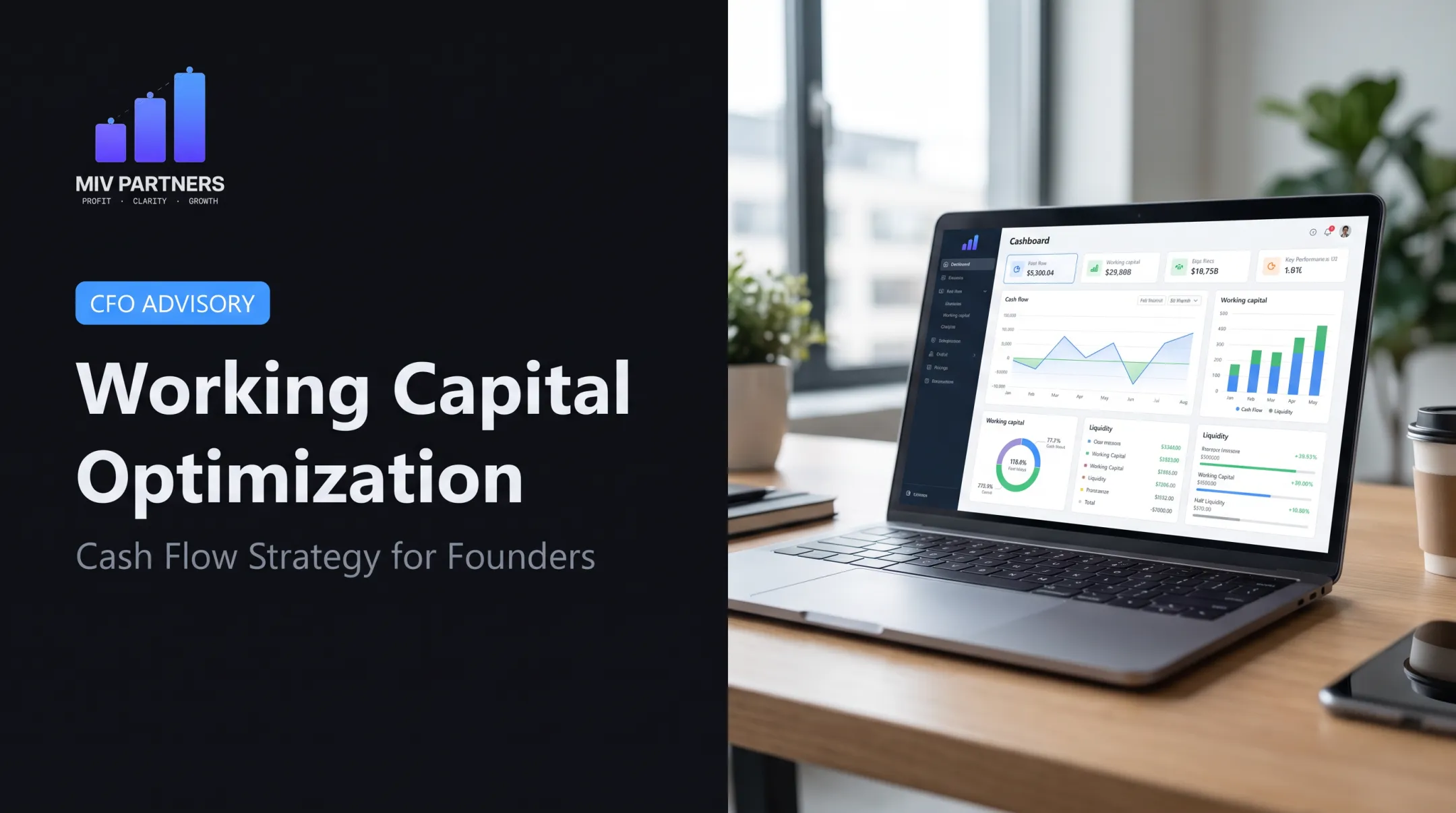

Many founders hit $1M-$15M in revenue and discover a painful truth: growth doesn't automatically create cash. It often does the opposite. Customer payments arrive late, vendor bills come due early, and suddenly a "good month" on paper turns into a scramble to make payroll.
The Federal Reserve found that roughly four in five small firms face payment-related challenges, with customer payments serving as the primary source of available cash. That's not a minor operational hiccup. It's the core reason many growing companies stall.
Cash flow optimization isn't about slashing expenses until you feel safe. It's about controlling timing and structure — when money comes in, when it goes out, and how much visibility you have before a shortfall hits. This guide covers the tactics, metrics, and systems that make that possible.
Key Takeaways
- Cash flow optimization manages the timing of money in and out—not paper profit alone
- Short-term AR/AP and expense fixes plus forecasting and KPIs build lasting cash stability
- Founder-led businesses in growth mode face outsized risk of cash gaps despite strong revenue
- A fractional CFO installs scalable systems without the cost of a full-time hire
What Is Cash Flow Optimization and Why It Matters
Cash flow optimization is the process of managing when money enters and exits your business to maximize liquidity at any given moment. It's different from profit tracking, which measures performance over a period but says nothing about when that cash actually lands in your account.
Here's the disconnect: your income statement can show a healthy profit while your bank balance tells a different story. A $50,000 invoice booked as revenue in March doesn't help you make payroll if the client doesn't pay until June.
Growing businesses feel this most acutely. A company generating $1M-$15M has typically outgrown basic bookkeeping, but hasn't yet built the financial infrastructure , including forecasts, dashboards, and KPI tracking, that a full-time CFO would normally provide. That gap in visibility is where cash problems hide until they become emergencies.
Common warning signs include:
- Revenue is climbing, but cash feels tighter than it should
- Leadership can't explain which customers or services are actually profitable
- Major decisions (hiring, expansion, financing) happen without financial clarity
- The business reacts to cash crunches instead of forecasting them
Reactive cash management responds after a shortfall hits — scrambling to cover payroll or pay vendors. Proactive cash flow optimization builds the forecasts and visibility to flag that gap weeks ahead, so you decide on hiring, expansion, or financing with cash already mapped.
Common Cash Flow Challenges Founders Face
Most cash flow problems trace back to a handful of recurring patterns. Spot them early and you can fix the gap before it hits payroll or vendors.
- Late customer payments. Intuit's 2026 survey found 59% of businesses had invoices overdue by 30+ days, with unpaid invoices averaging $17,700.
- Misaligned payment terms. Vendor bills often come due before customer payments arrive, creating a structural gap even when both sides pay on time.
- Overinvestment in inventory or overhead. Capital gets tied up in stock or fixed costs that could otherwise fund operations.
- Growth outpacing cash. Rising sales can mask higher expenses and slower collections when you scale headcount or inventory ahead of revenue.
- Lack of forward visibility. Without a forecast, founders discover shortfalls the week they hit, not the month before.

The Federal Reserve's most recent Small Business Credit Survey found that 56% of firms cited paying operating expenses and 51% cited uneven cash flows as ongoing challenges. These aren't edge cases. They're the norm for growing companies without a structured cash system.
How Can I Optimize My Cash Flow? Proven Strategies
Cash flow improves when you act on both sides of the cycle: getting paid faster and holding cash longer. Start with the levers below—most founder-led businesses see the biggest gains from receivables, vendor timing, and a living forecast.
Tighten Accounts Receivable
Late payments are often the single biggest lever. Focus on three habits:
- Invoice as soon as work is done (automate so bills never sit for days)
- Set payment terms in writing before you start
- Follow up on overdue balances on a fixed schedule, not when you remember
Early-payment discounts can help, but use them selectively. A 2% discount can equate to roughly 36% APY in effective cost. Offer one only when the cash-flow benefit clearly outweighs that expense.
Renegotiate Vendor Terms
Extending payment windows frees up cash without cutting revenue. Align due dates with when customer payments actually land, then document the new terms and start with your most critical vendors.
Control Variable Costs
Audit subscriptions, contractors, and overhead quarterly—not once a year. Cancel or renegotiate anything that no longer supports revenue so small recurring charges stop draining cash quietly.
Build a Rolling 13-Week Forecast
A weekly, rolling 13-week cash forecast is one of the most practical tools you can run. It surfaces shortfalls or surpluses before they hit, not after.
Update it every week with actual results and revised assumptions. Pair it with a longer view (about six months) when you are weighing hires, equipment, or financing so near-term liquidity and growth plans stay connected.

Improve Inventory Turnover
If you carry product, tie purchasing to real demand instead of guesswork. Excess stock is cash sitting on a shelf. Service businesses can apply the same idea to work-in-progress and prepaid costs: do not fund more pipeline than your collections can support.
Align Capital Decisions With Cash Reality
Hiring, expansion, and financing should follow a forward-looking cash plan, not gut instinct. If the forecast cannot fund the decision through the lag before new revenue arrives, pause or stage the spend until it can.
What Is a Healthy Cash Flow Ratio? Key Metrics to Track
Metrics matter more than gut feel. Here are the four worth tracking consistently.
| Metric | Formula | What It Signals |
|---|---|---|
| Operating Cash Flow Ratio | OCF ÷ current liabilities | Above 1.0 means operations generated enough cash to cover short-term liabilities |
| Cash Conversion Cycle (CCC) | DIO + DSO − DPO | Shorter cycle means cash moves faster through the business |
| Days Sales Outstanding (DSO) | (AR ÷ credit sales) × days | Measures how fast customers actually pay you |
| Days Payable Outstanding (DPO) | (AP ÷ COGS) × days | Measures how long you take to pay suppliers |
JPMorgan notes that a DSO of 30 days or less is standard for most B2B trade, though this varies by industry. Industry data from APQC puts median DPO around 40 days across sectors — useful as a peer comparison, not a hard rule.
On cash reserves: many advisors recommend 3-6 months of operating expenses as a buffer. Treat this as a starting policy, not a universal law.
A 2016 JPMorgan Chase Institute study of small businesses found a median cash buffer of just 27 days, with wide variation based on seasonality, payroll structure, and access to credit. Your right number depends on your specific risk profile.

Building Scalable Systems for Long-Term Cash Flow Health
Spreadsheets work fine at $500K in revenue. At $5M, they start to break. A CFO Research survey found that 73% of midsize companies relied primarily on spreadsheets for planning and forecasting — and more than 60% said the process simply took too long to be useful.
When planning lags that far behind reality, dashboards and rolling forecasts replace manual workbooks.
The Diagnose, Strategize, Install Model
MIV Partners, founded by Michel Chelnokov, CPA and MBA, uses a structured three-phase approach with founder-led clients:
- Diagnose (Weeks 2–3): Review profitability and cash flow to pinpoint margin erosion and cash gaps, then lock in a true baseline
- Strategize (Month 2): Build a financial roadmap across pricing, cost structure, and capital needs to stabilize cash going forward
- Install (Month 3+): Stand up executive dashboards and rolling forecasts tied to real decisions, so planning stays forward-looking

The point is simple: catch cash flow gaps and profit leaks before they hit the bank account.
CFO-Level Clarity, Without the Full-Time Cost
Once systems are in place, monthly reviews keep that discipline running:
- Track cash position against plan
- Compare actual results to forecast
- Flag liquidity risks while there's still time to act
It's the same cadence a full-time CFO would run, at a fractional cost built for $1M–$15M businesses.
Founders dealing with cash flow instability can start with a complimentary CFO Financial Diagnostic from MIV Partners. No commitment required — just a clear read on where cash and profit are leaking.
Frequently Asked Questions
How can I optimize my cash flow?
Tighten receivables through automated invoicing and consistent follow-up, renegotiate vendor payment terms, and build a rolling 13-week cash forecast. Combining short-term AR/AP fixes with long-term forecasting systems delivers the most durable results.
What is a healthy cash flow ratio?
An operating cash flow ratio above 1.0 means your operations generate enough cash to cover current liabilities. Below 1.0 signals you may be relying on financing or reserves to stay current on short-term obligations.
What's the difference between cash flow and profit?
Profit is an accrual-based accounting figure that counts revenue when earned, not when collected. Cash flow tracks the actual timing of money moving in and out, which is why a profitable business can still run short on cash.
How often should I update my cash flow forecast?
Update a rolling 13-week forecast weekly. This cadence catches emerging shortfalls or surpluses early enough to act, rather than reacting after the cash gap has already appeared.
What causes cash flow problems in growing companies?
The most common causes are late customer payments, vendor terms misaligned with collection timing, and overinvestment in inventory or overhead. Rising revenue often masks these issues until a shortfall forces the issue.
When should a business consider a fractional CFO for cash flow issues?
Consider one when cash gaps recur despite growing revenue, when major decisions like hiring or financing aren't backed by solid financial analysis, or when bookkeeping alone no longer gives you the strategic structure you need. These signals are common in founder-led businesses doing $1M–$15M in revenue.